
Engineering Validation
Claims are easy. Measurements are better.
ORM commerce infrastructure is validated through automated testing, controlled load tests, transactional safeguards and production performance analysis.
Engineering decisions supported by evidence, not assumptions.
Automated Validation
Domain behaviour and infrastructure boundaries are exercised through repeatable automated tests.
Measured Performance
Storefront, checkout and payment paths are tested under controlled concurrency and sustained request volume.
Transactional Safety
Inventory, payments, refunds and order transitions are protected by explicit invariants and guarded workflows.
Maintainable Architecture
Narrow contracts, composition factories and isolated domain services keep capabilities testable, replaceable and independently extensible.
Platform Performance
Performance measured across the stack.
Browser audits, application load tests and infrastructure monitoring are used together rather than treating one synthetic score as a complete measure of platform performance.
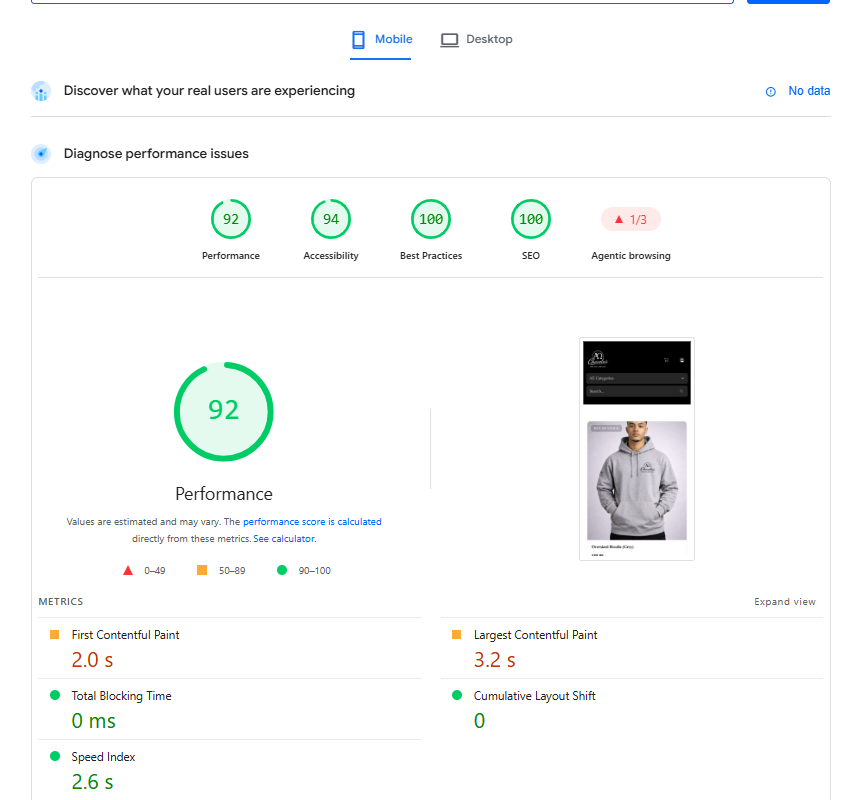
PageSpeed Insights result recorded against the live Chacalus commerce deployment.
Mobile accessibility audit covering document structure, labels, contrast and navigational behaviour.
Browser audit covering secure delivery, modern APIs and implementation quality.
Technical SEO audit covering crawlability, metadata, semantic markup and mobile compatibility.
Live Commerce Validation
Chacalus deployment. Measured result.
This mobile PageSpeed Insights capture was recorded against the live Chacalus commerce deployment, not an isolated prototype.
The captured run recorded 92 Performance, 94 Accessibility, 100 Best Practices and 100 SEO. Lighthouse and PageSpeed scores are laboratory measurements and may vary by test environment, network conditions, device simulation and page content.
Load Testing
Commerce flows tested under pressure.
Controlled k6 tests evaluate browse traffic, checkout behaviour, inventory contention and application stability under increasing concurrency.
Concurrent browsing users
Stable browsing workloads recorded application response times below approximately 15 milliseconds on the tested infrastructure.
Sustained virtual users
Soak testing remained stable under sustained concurrent traffic without application degradation or inventory inconsistency.
Checkout test requests
The complete controlled checkout scenario produced 3,468 completed flows in approximately 75 seconds.
Inventory oversells
Reservation and transaction behaviour prevented overselling throughout the controlled checkout stress test.
Checkout stress testing used controlled payment substitutes to isolate application, order and inventory behaviour. External payment-gateway throughput was not represented by these figures.
Automated Testing
Domain behaviour tested before deployment.
Automated tests cover business rules, domain contracts and infrastructure boundaries where failures could affect money, stock, currency conversion, customer accounts or operational history.
1,508
automated tests
Supported by 7,504 assertions across commerce domains, infrastructure boundaries, validation rules and guarded operational workflows.
Transactional Reliability
Designed around failure-sensitive workflows.
Commerce infrastructure must preserve consistency when requests are repeated, payments fail, stock changes, tax is calculated or fulfilment states evolve.
Idempotent operations
Repeat-sensitive workflows are designed to prevent unintended duplicate actions where the same request is retried.
Transaction boundaries
Related database changes are committed together or rolled back when an operation cannot complete safely.
Historical snapshots
Order and financial records preserve the context required to understand historical transactions after products or prices change.
State history
Operational transitions are recorded to retain visibility over order, payment and fulfilment progression.
Security Controls
Security treated as architecture.
Platform safeguards are applied across requests, services, persistence, authentication and operational logging rather than added as a final deployment step.
Platform Architecture
Isolated domains. One composed commerce platform.
ORM deployments share a common platform codebase while composition boundaries, narrow contracts and isolated domain services keep commerce capabilities independently testable and extensible.
Metrics require context.
Performance results reflect specific infrastructure, test scripts, datasets and controlled conditions. They demonstrate platform behaviour under the documented scenarios rather than guaranteeing identical results for every deployment.
Final performance depends on scope, integrations, traffic patterns, infrastructure allocation and client-specific implementation.
Discuss The Architecture
Review the engineering behind your platform.
A 30-minute consultation to discuss operational requirements, platform architecture, performance expectations and implementation strategy.
- Architecture and scope review
- Operational risk assessment
- Performance and integration requirements
Select a time that works for you.
Google Meet details are automatically added after booking.
Schedule A Call